Tuesday, 2 April 2024

Why is a Focus on Study Skills in Schools Important? https://www.globalmetacognition.com/post/why-is-a-focus-on-study-skills-in-schools-important

What Are Study Skills?

Study skills refer to a wide range of strategies, techniques, and behaviours that students employ to enhance their learning and academic performance. However, the understanding of study skills can vary among individuals and educational contexts. Some interpret study skills as the explicit methods and tools used for studying, such as note-taking, time management, and test-taking strategies. These skills focus on the practical aspects of studying and aim to optimize efficiency and effectiveness.


Others view study skills more broadly, encompassing broader cognitive, metacognitive, and socio-emotional abilities. In this perspective, study skills include critical thinking, problem-solving, self-regulation, goal setting, and reflection. These skills emphasize the development of higher-order thinking, self-awareness, and lifelong learning habits.


Ultimately, study skills encompass a spectrum of approaches and abilities that help students become more effective learners, but the specific understanding and emphasis may vary depending on the educational context and individual perspectives.


Why is Study Skill Development a Priority for Teachers?

Study skills development is a fundamental aspect of education that empowers students with the tools and strategies necessary for effective learning. By prioritizing study skills development in schools, educators can equip students with lifelong skills that will benefit them academically and beyond. Let's explore the top ten reasons why focusing on study skills development is crucial for student success.

  1. Enhances Academic Performance: Developing study skills equips students with effective learning strategies, enabling them to improve their academic performance and achieve their full potential.

  2. Boosts Confidence: As students gain mastery over study skills, they become more confident in their abilities to tackle academic challenges, leading to increased self-assurance and motivation.

  3. Improves Time Management: Study skills development helps students manage their time effectively, enabling them to balance their academic responsibilities, extracurricular activities, and personal commitments.

  4. Enhances Information Retention: By employing proven techniques such as note-taking and active reading, students can enhance their ability to absorb, process, and retain information.

  5. Encourages Critical Thinking: Study skills development promotes critical thinking by teaching students how to analyse information, evaluate sources, and approach learning tasks from multiple perspectives.

  6. Develops Problem-Solving Skills: By fostering study skills, educators empower students to become effective problem solvers, encouraging them to think creatively and find innovative solutions.

  7. Cultivates Self-Regulation: Study skills development encourages students to take ownership of their learning process, teaching them how to set goals, monitor progress, and make adjustments when necessary.

  8. Enhances Organization: Effective study skills involve developing organizational habits, such as keeping track of assignments, managing study materials, and creating structured study plans.

  9. Reduces Stress and Anxiety: When students possess strong study skills, they feel more prepared and in control, reducing stress and anxiety related to academic tasks and assessments.

  10. Prepares for Future Success: Study skills are not only essential for academic success but also for future endeavours. Students who possess strong study skills are better equipped to navigate higher education, careers, and lifelong learning.


Focusing on study skills development in schools yields numerous benefits for students. It enhances academic performance, boosts confidence, improves time management, and cultivates critical thinking and problem-solving skills. Moreover, study skills development empowers students to become self-regulated learners, fosters organizational habits, and reduces stress and anxiety. Ultimately, by prioritizing study skills development, educators are equipping students with the essential tools for success in their academic journey and beyond.

Tips & Tricks for Study Skill Development

  1. Explicitly Teach Study Skills: Introduce and explain various study skills to your students, emphasizing their importance and providing clear instructions on how to apply them effectively.

  2. Scaffold Learning: Break down complex study skills into smaller, manageable steps to guide students through the process. Gradually remove support as they become more proficient.

  3. Model and Demonstrate: Show students how to use study skills through live demonstrations, think-alouds, or video examples. Let them observe and understand the strategies in action.

  4. Provide Guided Practice: Offer structured opportunities for students to practice study skills with your guidance and support. Gradually release responsibility as they gain confidence and proficiency.

  5. Offer Resources and Materials: Provide students with study guides, graphic organizers, templates, and other resources that can assist them in applying study skills effectively.

  6. Differentiate Instruction: Recognize that students have different learning styles and preferences. Tailor your instruction and provide a variety of study skill options to cater to individual needs.

  7. Foster Collaboration: Encourage students to work together and share study strategies and techniques. Group discussions and peer support can enhance understanding and application of study skills.

  8. Provide Feedback: Regularly provide specific and constructive feedback to students regarding their use of study skills. Highlight their strengths and areas for improvement to guide their development.

  9. Encourage Reflection: Incorporate opportunities for students to reflect on their study practices and evaluate their effectiveness. Help them identify areas for growth and establish goals for improvement.

  10. Integrate Study Skills Across the Curriculum: Reinforce the use of study skills in various subjects and assignments. Show students how study skills are applicable beyond specific tasks, fostering their transferability.

  11. Celebrate Progress: Recognize and celebrate students' growth in using study skills. Acknowledge their efforts and achievements, motivating them to continue developing their skills.

  12. Collaborate with Colleagues: Engage in professional discussions with other teachers to share best practices and strategies for promoting study skills development in the classroom.

Remember, developing study skills is an ongoing process. Continually assess student needs, adjust instructional strategies accordingly, and provide opportunities for students to practice and refine their study skills throughout the school year.


Download Our Study Skills Development Toolkit

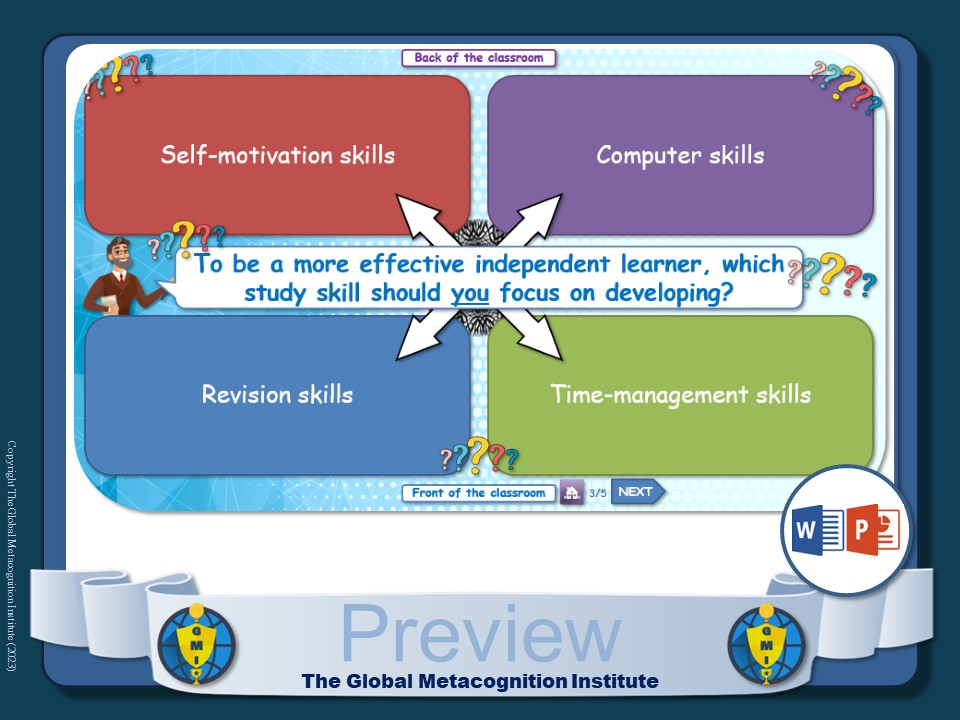
We've created a toolkit that will help students to develop their study skills. It uses a self-regulated learning approach that encourages students to plan, monitor, evaluate and regulate their approach to study-skills development. Click here to download!

'The Study Skills Development Toolkit' is your essential resource for empowering students to excel in their study skills. This comprehensive toolkit utilizes a self-regulated learning approach, fostering students' ability to plan, monitor, evaluate, and regulate their study skill development.

Included in the download are:

  • Study-Skills Reflection Workbook: Engage students in reflective exercises to enhance their study skills. Identify strengths, target areas for improvement, and set actionable goals.

  • Knowledge-Hunt Lesson: Explore the secrets of effective study skills through an engaging lesson that complements the workbook. Uncover strategies and develop metacognitive awareness.

  • Interactive Multi-Use Lesson: Adapt the versatile lesson to meet your teaching needs, promoting active learning and collaboration.

"The Study Skills Development Toolkit" draws upon research-based pedagogical approaches such as reflective learning, independent learning, metacognition, and self-regulated learning. Equip your students with the tools they need to become confident, self-directed learners.


Unlock their potential with 'The Study Skills Development Toolkit'- your guide to fostering study skills excellence. Download now and embark on a transformative journey of study skills growth!


A Self-Regulated Learning Approach to Study Skills Development

In the pursuit of academic success, students must develop study skills that empower them to effectively navigate their learning journey. The self-regulated learning cycle, consisting of planning, monitoring, evaluating, and regulating approaches to learning, offers a powerful framework for students to cultivate study skills mastery. In this article, we will explore each stage of the cycle and provide practical strategies to help students develop their study skills over time.

  1. Planning: Charting the Path to Study Skills Success Effective study skill development begins with thoughtful planning. Encourage students to set clear goals, break down tasks, and create a study schedule. By identifying specific study objectives, students can prioritize their learning and allocate time efficiently. Encourage them to consider different study strategies and techniques that align with their individual learning styles and preferences.

  2. Monitoring: Tracking Progress for Continuous Growth Monitoring progress is a critical component of study skill development. Students should regularly assess their performance and reflect on their study habits. Encourage them to track their learning outcomes, evaluate their understanding of the material, and identify areas that require further attention. By monitoring their progress, students can make timely adjustments to their study strategies, ensuring that they stay on the path to improvement.

  3. Evaluating: Understanding Strengths and Weaknesses Effective study skill development demands self-evaluation. Students should assess their study skills, identify strengths, and recognize areas for improvement. Encourage them to reflect on their study techniques, time management, note-taking, and organization skills. By recognizing their strengths and weaknesses, students can prioritize their efforts and focus on specific areas where they need to enhance their study skills.

  4. Regulating: Setting Targets and Adapting Strategies Regulating study skill development requires students to set clear targets and goals. Encourage them to establish specific and measurable objectives, such as improving time management or enhancing critical thinking skills. By breaking down their goals into actionable steps, students can develop an effective action plan. Additionally, they should be open to making necessary adjustments to their study strategies based on their self-evaluation. Encourage students to seek feedback, explore new study techniques, and adapt their approaches to optimize their study skill development.

In the journey towards study skills mastery, students must embrace the self-regulated learning cycle to effectively plan, monitor, evaluate, and regulate their approaches to learning. By empowering students to make comprehensive plans, monitor their progress, evaluate their strengths and weaknesses, and regulate their study skill development, we equip them with the tools they need to succeed academically. As educators, let us guide students in harnessing the power of self-regulated learning and pave the way for their study skills growth and lifelong success.


from The Global Metacognition Institute https://www.globalmetacognition.com/post/why-is-a-focus-on-study-skills-in-schools-important
via https://www.globalmetacognition.com/

Monday, 1 April 2024

Free Metacognition Worksheets & Resources https://www.globalmetacognition.com/post/free-metacognition-worksheets-resources

The Global Metacognition Institute is the leading publisher of teaching resources that focus on reflective learning, self-regulated learning, and metacognition in schools. Enhance your approach to teaching with the tools on this site...

Click on the picture to explore our range of free metacognition teaching resource downloads!

Our Resources Help By...

1. Increasing Levels of Metacognition

What is Metacognition? Metacognition refers to the ability to think about one's own thinking processes. It involves understanding how we learn, monitoring our progress, and making conscious decisions about our learning strategies.

Why is it Important? Metacognition is a vital skill that empowers students to become more aware of their learning journey. It allows them to take control of their learning by setting goals, evaluating their strategies, and adapting them as needed. Increased metacognition leads to more effective and efficient learning.

2. Creating Independent Learners

What is Independent Learning? Independent learning is the ability to take initiative and responsibility for one's own learning. It involves setting goals, planning, and executing learning activities with minimal guidance.

Why is it Important? Independent learners are more self-reliant and motivated. They develop problem-solving skills and the capacity to explore topics beyond the curriculum. Independent learning fosters a lifelong love for learning and prepares students for success beyond the classroom.

3. Boosting Reflective Learning

What is Reflective Learning? Reflective learning encourages students to look back on their learning experiences, analyse them, and extract valuable insights. It involves critical thinking and self-awareness.

Why is it Important? Reflective learning deepens understanding and promotes critical thinking. It allows students to connect theoretical knowledge to real-life situations, making learning more meaningful. This skill is essential for lifelong learning and personal growth.

4. Enhancing Dedicated Improvement & Reflection Time (DIRT)

What is DIRT? Dedicated Improvement & Reflection Time (DIRT) is a designated period where students review their work, receive feedback, and set goals for improvement.

Why is it Important? DIRT fosters a culture of continuous improvement. It enables students to see the value of feedback and self-assessment. By reflecting on their work and setting improvement goals, students become more engaged and proactive in their learning.

5. Promoting Self-Regulated Learning

What is Self-Regulated Learning (SRL)? Self-regulated learning involves students taking control of their learning processes, setting goals, planning, monitoring progress, and adjusting strategies.

Why is it Important? Self-regulated learners are more independent and capable of managing their own learning. They develop resilience and adaptability, essential skills in today's fast-paced world. SRL empowers students to become lifelong learners.

In conclusion, The Global Metacognition Institute's resources offer a multifaceted approach to transforming teaching. By increasing metacognition, fostering independent learners, boosting reflective learning, enhancing DIRT, and promoting self-regulated learning, these resources empower educators to create a dynamic and enriching educational experience for their students. Embracing these principles paves the way for a brighter future of education and lifelong learning.


Elevate Your Teaching with FREE Resources!

Are you ready to revolutionize your classroom? Dive into the world of cutting-edge education with our FREE teaching resources, meticulously designed to empower both you and your students.

Boost Metacognition: Unleash the Power of Thought!

Discover dynamic tools that will awaken your students' inner thinkers. Our resources are tailored to nurture metacognition, helping learners understand their learning processes, set goals, and take charge of their educational journey.

Increase Self-Regulated Learning: Empower Independent Learners!

Say goodbye to passive learning! Our FREE teaching resources equip you with strategies that transform students into proactive, self-regulated learners. Watch as they plan, monitor, and adjust their learning techniques, achieving unparalleled academic success.

Encourage Reflective Learning: Foster Wisdom & Insight!

Prepare your students for a world of limitless possibilities. Our resources cultivate reflective learning, encouraging them to delve deep into their experiences, connect the dots, and apply newfound wisdom to real-life situations.


Are you ready to embark on this educational odyssey? Access our complimentary teaching resources now and set forth on a voyage of transformation, growth, and scholarly accomplishment within your classroom.


from The Global Metacognition Institute https://www.globalmetacognition.com/post/free-metacognition-worksheets-resources
via https://www.globalmetacognition.com/

Thursday, 28 March 2024

Student Self-Assessment: A Practical Guide for Teachers https://www.globalmetacognition.com/post/student-self-assessment-a-practical-guide-for-teachers

Empowering students to take charge of their learning journey through self-assessment is a transformative pedagogical approach. By fostering introspection and metacognition, teachers can cultivate independent learners who actively engage with their progress and growth. This practical guide outlines effective strategies that educators can employ to encourage self-assessment in their lessons, creating a dynamic classroom environment that nurtures autonomy, critical thinking, and intrinsic motivation.

1. Set Clear Learning Objectives

Begin each lesson with clearly defined learning objectives. By understanding the goals, students can better assess their progress against these benchmarks, enabling them to gauge their achievements and areas for improvement.

2. Create Rubrics and Criteria

Develop rubrics or assessment criteria that outline the expected standards for assignments and tasks. Share these with students beforehand so they know what to aim for and can use them as reference points for self-assessment. Check out the resources at the end of this articles if you ant to save time!

3. Promote Reflection

Incorporate regular moments for reflection within lessons. Encourage students to ponder their understanding, methods used, and challenges faced. This practice cultivates metacognition and enhances self-awareness.

4. Peer and Group Assessments

Introduce peer and group assessments. Assign students to assess their peers' work using predetermined criteria. This practice not only promotes self-assessment in evaluating others but also fosters a deeper understanding of assessment standards.

5. Use Self-Assessment Tools

Provide self-assessment tools such as checklists or self-evaluation forms. These resources guide students in evaluating their work against specific criteria, prompting them to critically assess their efforts.

6. Goal-Setting Exercises

Incorporate goal-setting exercises where students identify personal targets for improvement. This practice empowers them to take ownership of their learning journey and sets the stage for self-assessment.

7. Classroom Discussions

Initiate classroom discussions where students share their self-assessment findings. This encourages them to articulate their thought processes, fostering communication skills and collaborative learning.

8. Offer Timely Feedback

Provide timely and constructive feedback on assignments. This informs students' self-assessment and helps them make informed decisions about areas needing further attention.

9. Reflect on Progress

At the end of a unit or term, encourage students to reflect on their progress over time. This holistic review highlights their growth and reinforces the value of self-assessment.

10. Encourage Adaptability

Celebrate mistakes as opportunities for growth. Encourage students to identify where they went wrong and how they can adjust their strategies in the future.

11. Model Self-Assessment

Model self-assessment behaviours as a teacher. Share your own reflections and improvements, demonstrating that self-assessment is a lifelong learning skill.

12. Foster a Supportive Environment

Create a safe space where students feel comfortable acknowledging areas of weakness. Foster a growth mindset that views challenges as stepping stones to improvement.

Conclusion

Empowering students with self-assessment skills is an investment in their academic and personal growth. By implementing these practical strategies, teachers lay the foundation for a classroom where students take ownership of their learning, develop critical thinking skills, and cultivate a mindset of continuous improvement. As educators, we hold the key to nurturing independent learners who are not just recipients of knowledge, but active participants in their educational journey.


We've created two downloadable resources that are focused on self-assessment. They are suitable for students aged 11-18 and can be used in any school subject.

The first is a set of five self-assessment worksheets that focus on subject-specific assessment. The second is a self-assessment session based around a six-page printable self-assessment workbook; this resource focuses on a more generalised self-assessment so that students can look at 'the bigger picture' when it comes to evaluating both their work, their effort, and their strengths and weaknesses as learners. Use the following buttons to download these self-assessment teaching resources now...

Previews...

Elevate Learning with Our Self-Assessment Teaching Resources!

Unlock the true potential of your students with our cutting-edge self-assessment teaching resources! Designed to ignite a passion for learning and cultivate essential skills, our resources empower students to take the reins of their own educational journey.

Imagine students who are not just passive learners, but active participants in their growth. Our carefully crafted resources seamlessly integrate into your teaching approach, fostering a culture of self-awareness and achievement.

With our tools, students learn to set goals, track progress, and reflect on their learning path, all while developing crucial skills like critical thinking and self-regulation.

Whether in the classroom or through remote learning, our resources adapt to diverse environments, making learning engaging and personalized.

Join countless educators who are already witnessing the transformative impact of our self-assessment resources. Experience the joy of seeing your students light up as they realize their own capabilities and chart a course towards success.

Don't miss this chance to revolutionize your teaching approach and inspire a lifelong love for learning. Download our self-assessment resources today and watch your students flourish like never before!


from The Global Metacognition Institute https://www.globalmetacognition.com/post/student-self-assessment-a-practical-guide-for-teachers
via https://www.globalmetacognition.com/

Tuesday, 26 March 2024

Why Mind-Mapping Skills Boost Learning Outcomes https://www.globalmetacognition.com/post/why-mind-mapping-skills-boost-learning-outcomes

Mind mapping is a powerful tool that can help students organize their thoughts and ideas in a visual and structured way. When used effectively, mind mapping can greatly enhance students' ability to learn, think critically, and solve problems. Why? In this article, we will explore the benefits of mind-mapping skills in boosting educational attainment.

  1. Improving memory retention: Mind mapping helps students retain information more effectively. By organizing information in a visual and structured way, students are better able to remember important concepts and details. This can be especially useful when studying for exams or preparing for presentations.
  2. Enhancing critical thinking: Mind mapping encourages students to think critically about the information they are organizing. By breaking down complex ideas into smaller, more manageable parts, students can more easily identify patterns and connections, leading to a deeper understanding of the material.
  3. Boosting creativity: Mind mapping is a creative process, and it can help students develop their creativity and innovation skills. By incorporating images, colours, and other visual elements into their mind maps, students are able to approach problems from a new perspective, leading to more creative solutions.
  4. Encouraging active learning: Mind mapping encourages students to actively engage with the material they are learning. Rather than simply reading or listening to information, students are required to actively process and organize it in a meaningful way.
  5. Improving organization and time management: Mind mapping can help students stay organized and manage their time more effectively. By breaking down complex projects or assignments into smaller, more manageable parts, students are better able to stay on track and meet deadlines.
  6. Increasing engagement and motivation: Mind mapping is an engaging and interactive process, which can help increase students' motivation to learn. By providing a more dynamic and stimulating way to organize information, students are more likely to stay engaged and motivated throughout the learning process.
  7. Facilitating collaboration: Mind mapping can be a powerful tool for collaboration, allowing students to work together to organize and synthesize information. By sharing their mind maps with each other, students can identify different perspectives and approaches to the material, leading to a richer and more nuanced understanding of the topic.
  8. Fostering self-reflection: Mind mapping can also encourage self-reflection in students. By visualizing their thoughts and ideas, students can gain a deeper understanding of their own thinking processes and identify areas where they may need to improve their understanding or knowledge.
  9. Supporting differentiated instruction: Mind mapping can be used to support differentiated instruction, allowing students to organize information in a way that best suits their individual learning style. Students can tailor their mind maps to their own needs, using different colours or images to highlight key concepts or ideas.
  10. Promoting lifelong learning: Finally, mind mapping can promote lifelong learning by providing students with a powerful tool for organizing and synthesizing information. Students who develop strong mind-mapping skills in school can continue to use them throughout their academic and professional careers, allowing them to stay organized and productive even when faced with complex or challenging tasks.

20 Tips & Tricks to Help Students Get the Most From Mind-Mapping Activities

As a teacher, how can you help students get the most benefits from mind-mapping activities in your lessons? Consider the following twenty tips & tricks!

  1. Start with a clear objective: Before beginning a mind-mapping activity, it's important to have a clear objective in mind. This will help students stay focused and organized as they create their maps.
  2. Choose the right tool: There are many different tools available for creating mind maps, including online tools and physical paper and pens. Choose a tool that works best for your students and the resources available to you.
  3. Introduce the concept of mind mapping: Make sure that your students understand what mind mapping is and how it can be used to organize information.
  4. Model the process: Create your own mind map in front of your students, explaining your thought process as you go.
  5. Provide examples: Show your students examples of mind maps that relate to the topic they are studying.
  6. Encourage creativity: Encourage your students to be creative with their mind maps, using colours, images, and other visual elements to make them more engaging.
  7. Break it down: If a task seems overwhelming, encourage students to break it down into smaller parts and create a mind map for each part.
  8. Use keywords: Use keywords to help students identify the most important concepts and ideas.
  9. Highlight connections: Encourage students to highlight connections between different concepts and ideas on their mind maps.
  10. Review and revise: Encourage students to review and revise their mind maps as they learn more about the topic.
  11. Use mind mapping as a pre-writing activity: Encourage students to use mind mapping as a pre-writing activity to help them organize their thoughts before beginning a writing assignment.
  12. Use mind mapping as a note-taking tool: Encourage students to use mind mapping as a note-taking tool during lectures or when reading assigned texts.
  13. Use mind mapping for group projects: Encourage students to create mind maps as a group when working on a collaborative project.
  14. Use mind mapping for problem-solving: Encourage students to use mind mapping to break down complex problems into smaller, more manageable parts.
  15. Use mind mapping for goal-setting: Encourage students to use mind mapping to set and track their academic or personal goals.
  16. Use mind mapping for test preparation: Encourage students to use mind mapping to review and study for tests and exams.
  17. Use mind mapping for project planning: Encourage students to use mind mapping to plan out projects or assignments before beginning work.
  18. Use mind mapping for brainstorming: Encourage students to use mind mapping to brainstorm ideas for creative projects or problem-solving tasks.
  19. Use mind mapping for self-reflection: Encourage students to use mind mapping to reflect on their own learning and identify areas where they may need to improve.
  20. Provide feedback: Provide feedback on your students' mind maps, highlighting areas where they have done well and offering suggestions for improvement.

We've created the perfect downloadable toolkit for you to use with your students in order to help them develop their mind-mapping skills! Click here to have a look!


from The Global Metacognition Institute https://www.globalmetacognition.com/post/why-mind-mapping-skills-boost-learning-outcomes
via https://www.globalmetacognition.com/

Monday, 18 March 2024

Metacognition & Formative Assessment: Using Assessment Wrappers Effectively https://www.globalmetacognition.com/post/metacognition-formative-assessment-using-assessment-wrappers-effectively

Assessment is a crucial aspect of education, and formative assessment, in particular, has been identified as an effective means of promoting learning. Formative assessments are assessments that are carried out during the learning process to evaluate students' understanding of concepts and provide feedback that can be used to improve their learning. One effective strategy for enhancing the benefits of formative assessment is the use of assessment wrappers.

Assessment wrappers are student reflection activities that are undertaken before and after formative assessments. They are designed to encourage metacognition and self-regulated learning, which are essential skills for academic success. Metacognition refers to the ability to reflect on one's thinking and learning processes, while self-regulated learning involves the ability to monitor and control one's learning activities.

Assessment wrappers are typically short activities that can be completed in a few minutes. They involve students reflecting on their learning, thinking about their goals, and planning how to improve their learning. Assessment wrappers are usually completed using a worksheet or online tool that prompts students to reflect on specific questions related to their learning.

Before the formative assessment, students are asked to complete an assessment wrapper that asks them to reflect on their learning so far. This might involve thinking about what they already know about the topic, identifying areas of weakness or uncertainty, and setting goals for the upcoming assessment. By completing this activity, students are encouraged to engage in metacognitive thinking, which can help them to identify areas where they need to focus their efforts to improve their learning.

After the formative assessment, students are asked to complete a second assessment wrapper that asks them to reflect on their performance on the assessment. This might involve thinking about what they did well, identifying areas where they could improve, and planning how to address any areas of weakness. By completing this activity, students are encouraged to engage in self-regulated learning, which can help them to take ownership of their learning and make adjustments to their learning strategies to improve their performance.

Research has shown that the use of assessment wrappers can have a positive impact on students' academic performance. One study found that students who completed assessment wrappers before and after formative assessments showed higher levels of academic achievement compared to students who did not complete assessment wrappers. Other studies have found that assessment wrappers can promote metacognitive thinking and self-regulated learning, which can lead to better academic outcomes.


We've released two assessment wrapper resources that will help you to implement this metacognitive strategy: printable assessment wrapper worksheets and a 'virtual assessment wrapper'. The printable assessment wrapper worksheets are a great way to make metacognitive work more visible and to track progress when it comes to metacognitive awareness; the virtual lesson wrapper is ideal for teachers who wish to save on printing costs.


Getting the Most Out of Assessment Wrapper Activities: Tips & Tricks

Here are some tips and tricks for using assessment wrappers with students.

  1. Start with clear objectives Before using assessment wrappers, it is important to set clear objectives for the formative assessment. This will help students to understand the purpose of the assessment and to focus their reflection activities on areas that are most relevant to their learning.
  2. Use a consistent format To make assessment wrappers as effective as possible, it is important to use a consistent format for the reflection activities. This will help students to understand what is expected of them and to develop a routine for engaging in metacognitive thinking and self-regulated learning.
  3. Make reflection activities relevant The reflection activities in assessment wrappers should be relevant to the formative assessment and the learning objectives. This will help students to engage more deeply in the reflection process and to identify areas where they need to focus their efforts to improve their learning.
  4. Provide guidance Students may need guidance on how to engage in metacognitive thinking and self-regulated learning, particularly if they are not familiar with these concepts. Teachers can provide guidance by modelling reflective thinking and providing examples of how to identify areas of weakness and set goals for improvement.
  5. Use technology There are many online tools available for creating and distributing assessment wrappers, including Google Forms and Microsoft Forms. These tools can make it easy for teachers to create assessment wrappers and for students to complete them, even if they are working remotely.
  6. Allow time for reflection To make the most of assessment wrappers, it is important to allow enough time for students to engage in reflective thinking. This may require setting aside time in class for students to complete the reflection activities, or providing students with homework assignments that include reflection activities.
  7. Use reflection activities as a basis for feedback The reflection activities in assessment wrappers can provide valuable feedback that teachers can use to guide their instruction. Teachers can use the information gathered from the reflection activities to identify areas where students are struggling and to tailor their instruction to meet the needs of individual students.
  8. Make reflection activities a regular part of formative assessment To make assessment wrappers as effective as possible, it is important to make reflection activities a regular part of formative assessment. This will help students to develop the habit of engaging in metacognitive thinking and self-regulated learning, which are essential skills for academic success.

In conclusion, assessment wrappers are a powerful tool for promoting metacognition and self-regulated learning among students during formative assessment work. By using a consistent format, providing guidance, and allowing time for reflection, teachers can help students to develop the essential skills they need to succeed academically. By making reflection activities a regular part of formative assessment, teachers can help students to take ownership of their learning and to make continuous progress toward their goals.


from The Global Metacognition Institute https://www.globalmetacognition.com/post/metacognition-formative-assessment-using-assessment-wrappers-effectively
via https://www.globalmetacognition.com/

Tuesday, 12 March 2024

Using Reflective Essay Writing to Boost Metacognition & Nurture Self-Regulated Learning https://www.globalmetacognition.com/post/using-reflective-essay-writing-to-boost-metacognition-nurture-self-regulated-learning

Student reflection is a valuable tool for promoting metacognition and self-regulated learning. Through engaging in the process of planning, monitoring, evaluating, and regulating their learning, students can gain a deeper understanding of their own learning processes, identify areas for improvement, and make meaningful adjustments to their learning strategies.

One effective way to encourage students to engage in this process is through writing reflective essays that focus on planning, monitoring, evaluating, and regulating their approaches to learning. This applies phases of 'The Metacognitive Cycle' and 'The Self-Regulated Learning Cycle' to essay writing which both improves the reflective essay which means students are practising the principles of metacognition and self-regulation during such activities! This article will explore how these student reflection essay writing activities can help to improve student attainment, raise levels of metacognition, and boost self-regulated learning.

The Self-Regulated Learning Cycle

Planning

The first step in this process is planning. This involves students reflecting on their learning goals and identifying specific areas they want to focus on. By setting specific, measurable, attainable, relevant, and time-bound (SMART) goals, students can gain clarity on what they want to achieve and develop a roadmap for how to get there. This process helps students to develop a sense of purpose and direction in their learning, which in turn improves their motivation and engagement.

Monitoring The second step in this process is monitoring. Students engage in self-assessment and collect evidence of their progress towards their goals. This might involve keeping a learning journal, tracking their progress using a digital tool, or seeking feedback from peers or teachers. By monitoring their progress, students can identify areas where they need to focus their efforts and adjust their strategies accordingly. This promotes metacognition by encouraging students to think about their own thinking and gain a deeper understanding of how they learn best.

Evaluating

The third step in this process is evaluating. Students reflect on their progress and assess whether they have met their learning goals. This involves analyzing their evidence and reflecting on their successes and challenges. By evaluating their progress, students gain a deeper understanding of their strengths and weaknesses, which can inform their future learning strategies. This also promotes self-regulated learning by encouraging students to take ownership of their learning and make meaningful adjustments to their strategies.

Regulating

The final step in this process is regulating. Students use their reflections to make meaningful adjustments to their learning strategies. This might involve seeking additional resources, practicing new study strategies, or adjusting their goals based on their progress. By regulating their learning, students become more self-aware and better able to identify areas where they need to focus their efforts. This promotes metacognition and self-regulated learning by encouraging students to take an active role in their own learning.

Benefits

The benefits of student reflection essay writing activities are numerous. By engaging in this process, students become more self-aware and better able to identify areas where they need to focus their efforts. They also become more accountable for their own learning, taking ownership of their progress and success. This leads to increased motivation and engagement, and ultimately improved academic performance. Additionally, student reflection essays promote metacognition and self-regulated learning, which are critical components of effective learning. By engaging in this process, students become better able to regulate their own learning and make meaningful adjustments to their strategies as needed.

Conclusion

Student reflection essay writing activities that focus on planning, monitoring, evaluating, and regulating approaches to learning can help to improve student attainment, raise levels of metacognition, and boost self-regulated learning. By engaging in this process, students become more self-aware, accountable, and motivated, and ultimately achieve greater success in their academic pursuits. Teachers can support this process by providing guidance, feedback, and opportunities for reflection, helping to ensure that all students have the tools they need to succeed.


We've created a useful resource to help structure and guide metacognitive reflection essay writing - Metacognitive Reflection Essay Writing Toolkit! This metacognition teaching resource serves two primary functions:

  • To teach students how to use the metacognitive cycle (planning, monitoring, evaluating and regulating) in relation to essay-writing: developing essay-writing skills
  • To use essay-writing tasks as a way to encourage metacognitive reflection and help students gain metacognitive knowledge: developing metacognitive and self-regulated learning skills

The learning sessions guide students through the essay writing process and dedicate time to planning, monitoring, evaluating and regulating the essay writing process. Twelve metacognitive/ self-regulated learning reflection topic options are provided with hints as to what students might want to include in their essays. The topics are:

  1. Building On My Strengths & Weaknesses in This Subject
  2. Effective Revision & Exam Preparation Strategies
  3. How To Learn More During Lessons
  4. How My Behaviour Impacts My Learning & My Rate of Progress
  5. How Do My Emotions, Moods & Attitudes Impact My Learning?
  6. Metacognition, Self-Regulation & Independent Learning in This Subject
  7. What Could I Do Differently In Order to Maximise Learning?
  8. How To Boost My Learning Power
  9. The Ideal State of Mind for Learning & How I Can Cultivate It
  10. My Obstacles to Learning & How I Plan To Overcome Them
  11. Factors That Influence My Ability to Learn and Remember Learning
  12. What Approach to Learning Works Best For Me

Essay topics 1-6 are can be used by teachers of any subject to foster metacognition and lead students towards metacognitive knowledge their particular school subject whilst essay topics 6-12 are general metacognitive reflection rubrics.

In addition to promoting metacognition and self-regulated learning, our goal is to collaborate with educators in fostering greater levels of learner autonomy among students. As such, our essay-writing sessions include instructions that guide students towards developing their own assessment criteria. At the end of each session, students will use these criteria to evaluate their own work. This approach is closely aligned with the planning stage of the metacognitive cycle and encourages students to carefully consider task requirements before beginning their work.


from The Global Metacognition Institute https://www.globalmetacognition.com/post/using-reflective-essay-writing-to-boost-metacognition-nurture-self-regulated-learning
via https://www.globalmetacognition.com/

Saturday, 2 March 2024

Using Lesson Wrappers to Boost Metacognition https://www.globalmetacognition.com/post/using-lesson-wrappers-to-boost-metacognition

As a teacher, you are always looking for ways to improve your lessons and help your students learn more effectively. One tool that has gained popularity in recent years is the use of lesson wrappers. Lesson wrappers are a reflective tool that teachers can use to help students process and internalize the information they learned in a lesson. In this article, we will discuss what lesson wrappers are, the benefits of using them, and how to get the most out of using them in your lessons.

What are Lesson Wrappers?

A lesson wrapper is a reflective tool that can be used at the start and end of a lesson (thus 'wrapping' the lesson) to help students process and internalize the information they have learned. It is a brief activity that allows students to reflect on what they have learned and to think about how they can apply it in the future. Lesson wrappers can take many forms, such as a journal entry, a discussion, or a quiz, and can be completed individually or in groups.

Benefits of Using Lesson Wrappers

There are many benefits to using lesson wrappers in your lessons. First and foremost, they can help students to better understand and remember the material they have learned. By reflecting on what they have learned, students are able to consolidate their knowledge and connect it to prior knowledge. This can help them to retain the information and apply it in future contexts.

Lesson wrappers can also help to improve metacognition and self-regulation skills. When students reflect on their learning, they become more aware of their own thinking processes and can identify areas where they need to improve. This can lead to better self-regulation, as students learn how to monitor their own learning and make adjustments as needed.

Finally, lesson wrappers can help to improve student engagement and motivation. By providing students with an opportunity to reflect on what they have learned and connect it to their own experiences and interests, they are more likely to be engaged and motivated to learn.

How Lesson Wrappers Boost Metacognition & Self-Regulated Learning

Lesson wrappers are a type of reflection activity that are used at the start and end of a lessons to help students think about what they have learned, how they have learned it, and how they can use that knowledge in the future. These activities are an effective strategy for raising levels of metacognition and boosting self-regulation and self-regulated learning in the classroom for several reasons; use of lesson wrappers:

  1. Promotes Reflection: By engaging in a reflective activity, students are encouraged to think about their learning process, identify what they found challenging, and consider strategies that could help them overcome those challenges in the future. This promotes metacognition and helps students to better understand how they learn.
  2. Encourages Self-Assessment: Lesson wrappers often require students to evaluate their own performance, which helps them to become more aware of their strengths and weaknesses. This self-assessment can be a powerful tool for promoting self-regulation, as it enables students to identify areas where they need to improve and take action to address those areas.
  3. Provides Feedback: Lesson wrappers can also provide feedback to the teacher about how well the lesson was understood and how effective the teaching strategies were. This information can be used to adjust future lessons to better meet the needs of the students.
  4. Fosters Autonomy: By encouraging students to take an active role in their own learning, lesson wrappers foster a sense of autonomy and ownership over the learning process. This can lead to increased motivation and engagement, which are important factors for successful learning.
  5. Encourages Engagement in 'The Metacognitive Cycle': Lesson wrappers engage students in all stages of the metacognitive cycle (planning, monitoring, evaluating, and regulating learning).

In summary, lesson wrappers are an effective strategy for promoting metacognition, self-regulation, and self-regulated learning in the classroom. By encouraging students to reflect on their learning, evaluate their own performance, and take an active role in the learning process, lesson wrappers can help students to become more effective and efficient learners.

How to Get the Most Out of Using Lesson Wrappers

To get the most out of using lesson wrappers in your lessons, it is important to keep a few key things in mind. First, it is important to choose the right type of wrapper for your lesson. Different types of wrappers may be more effective for different types of lessons, so it is important to choose one that is appropriate for the content and goals of your lesson.

Second, it is important to provide clear instructions for completing the wrapper. Make sure that students understand what they are supposed to do and how they should do it. You may want to provide a model or example for students to follow, especially if they are unfamiliar with the type of wrapper you are using.

Third, it is important to give students enough time to complete the wrapper. While it may be tempting to rush through the reflection activity in order to move on to the next lesson, it is important to give students enough time to really engage with the material and think deeply about what they have learned.

Finally, it is important to use the information gathered from the wrappers to inform future instruction. By reviewing the responses from the wrappers, you can identify areas where students may be struggling or where they need additional support. This can help you to adjust your teaching to better meet the needs of your students.


We've created lesson wrappers that you can download and use today. Our printable lesson wrappers are ideal for making progress visible whilst our 'Virtual Lesson Wrapper' is a way of using the lesson wrapper technique without needing to print!

This download contains ten different lesson wrappers and is a comprehensive collection that will enhance learning in your classes!

This lesson wrapper is delivered via PowerPoint and features fifty metacognition and self-regulated learning activity slides; twenty-five that can be used at the start of lessons and twenty-five that can be used at the end of lessons.


from The Global Metacognition Institute https://www.globalmetacognition.com/post/using-lesson-wrappers-to-boost-metacognition
via https://www.globalmetacognition.com/