Monday, 19 August 2024

The Seven-Step Model for Metacognition in the Classroom https://www.globalmetacognition.com/post/the-seven-step-model-for-metacognition-in-the-classroom

In 2011, the EEF Teaching and Learning Toolkit was launched to bridge the gap between educational research and classroom practice. Since then, the term "metacognition and self-regulation" has become a buzzword in education, popping up in discussions about effective teaching strategies. It's consistently ranked as one of the most popular topics in the Toolkit, having been accessed over 120,000 times.


The Toolkit rates metacognition and self-regulation as having a very high impact on student progress—equivalent to an additional seven months' worth of progress when used effectively. What’s more, it’s a low-cost strategy backed by extensive evidence, making it particularly beneficial for disadvantaged students. However, while the potential impact is significant, there’s still a lot of uncertainty about how to apply these strategies effectively in the classroom. Although learners naturally develop some level of metacognition, and many teachers support it intuitively in their teaching, there’s no one-size-fits-all method for implementing it. It can be challenging to pinpoint exactly what metacognitive knowledge and skills look like in practice.


In 2018, the EEF published a guidance report on metacognition and self-regulated learning. This report reviews the best available research and provides practical advice for teachers and school leaders on how to cultivate metacognitive skills in their students while also addressing common misconceptions about metacognition.


What Exactly is Metacognition and Self-Regulation?


Metacognition is often described simply as "thinking about thinking," but this definition doesn’t fully capture its complexity in the classroom. At its core, metacognition involves students' ability to monitor, direct, and review their learning. Effective metacognitive strategies encourage students to reflect more deeply on how they learn. Self-regulation, on the other hand, refers to how aware students are of their strengths and weaknesses and the strategies they use to learn. It’s about how they motivate themselves to engage in learning and develop strategies to improve their learning process.


Psychologist Barry Zimmerman provides a helpful description of a self-regulated learner:


“These learners are proactive in their efforts to learn because they are aware of their strengths and limitations and because they are guided by personally set goals and task-related strategies, such as using an arithmetic addition strategy to check the accuracy of solutions to subtraction problems. These learners monitor their behaviour in terms of their goals and self-reflect on their increasing effectiveness. This enhances their self-satisfaction and motivation to continue to improve their methods of learning.”


Breaking Down Self-Regulated Learning


Self-regulated learning can be divided into three key components: cognition, metacognition, and motivation.


1. Cognition involves the mental processes used in understanding, learning, and remembering. Cognitive strategies are specific techniques that help students acquire knowledge and complete tasks—such as using mnemonic devices for memorisation or applying problem-solving methods in maths.

2. Metacognition is about how students think about and manage these strategies. It involves planning, monitoring, and evaluating their learning process.

3. Motivation is the drive that compels students to engage their cognitive and metacognitive skills in the first place. Without motivation, even the best strategies won’t be effectively applied.


It’s important to note that while metacognition often gets the spotlight, it’s no more or less important than cognition or motivation. You can’t be metacognitive without the cognitive strategies, and those strategies won’t be used effectively without motivation.


A Model for Metacognitive Thinking


The EEF offers a useful model to illustrate what metacognition looks like. It starts with metacognitive knowledge, which includes understanding the task at hand, knowing the strategies to complete it, and being aware of one’s own strengths and weaknesses. Metacognitive regulation then involves using this knowledge to plan, monitor, and evaluate. For example, do you understand the task well enough to plan it effectively? Are you monitoring your progress and adjusting strategies as needed? At the end of the task, are you evaluating how successful you were and considering what you might do differently next time?


Most teachers naturally engage in this type of thinking daily, but it doesn’t have to be left to chance with students. We can explicitly teach them to be metacognitive by making these thought processes clear and encouraging them to think in this way.


How to Incorporate Metacognition in the Classroom


There are many strategies for embedding metacognition into classroom practice, and these will vary depending on the student, subject, and task. Research suggests that metacognitive strategies are most effective when they’re woven into the curriculum and taught through subject content, rather than as standalone lessons.


The EEF recommends a seven-step model for explicitly teaching metacognitive strategies, which can be applied across subjects and age groups:


1. Activating prior knowledge

2. Explicit strategy instruction

3. Modelling of learned strategy

4. Memorisation of strategy

5. Guided practice

6. Independent practice

7. Structured reflection


This approach helps students build solid subject knowledge and understanding, forming the basis for independent practice followed by structured reflection on the learning process. For metacognitive thinking to become ingrained, it must be practiced consistently and applied to real learning contexts. Let's have a closer look at what each one entails...


Activating prior knowledge involves helping students connect new information to what they already know. This step is crucial because it allows students to anchor new learning in familiar concepts, making it easier to understand and retain new material. For instance, in a science lesson on ecosystems, a teacher might begin by asking students what they already know about food chains or animals’ roles within an ecosystem. This discussion prompts students to recall and share their existing knowledge, setting the stage for new information to be integrated. Another example could be in a history class, where a teacher is about to introduce the topic of World War II. The teacher might first ask students to discuss what they remember about the causes and effects of World War I. By revisiting previous lessons, students can build a bridge between the two wars, making it easier for them to grasp the complexities of the new topic.


Explicit strategy instruction involves directly teaching students specific strategies that can help them tackle learning tasks. This step requires the teacher to clearly explain and demonstrate how to use these strategies. For example, in a maths lesson on solving word problems, the teacher might teach a strategy like the “CUBES” method, which stands for Circle the numbers, Underline the question, Box the keywords, Eliminate unnecessary information, and Solve the problem. The teacher would explain each step, show how to apply it, and then have students practice it on their own. In a reading comprehension lesson, a teacher might introduce the strategy of summarising, where students are taught to identify the main ideas and key details of a passage. The teacher could model this by reading a paragraph aloud and then summarising it in a few sentences, explaining their thought process along the way. Students would then practice summarising other paragraphs, gradually developing their ability to distill information.


Modelling involves the teacher demonstrating how to apply the strategies that have been taught. This step helps students see how to use the strategies in action and provides a clear example for them to follow. In a writing lesson, for instance, a teacher might model how to plan an essay. The teacher could think aloud while outlining the main points, deciding on the structure, and choosing evidence to support their arguments. This demonstration gives students a concrete example of how to approach their own essay writing. In a science class, the teacher might model how to design an experiment. They could walk students through the process of forming a hypothesis, identifying variables, and planning the steps of the experiment. By showing each step and explaining their reasoning, the teacher helps students understand how to approach their own experimental designs.


Memorisation of strategy is about ensuring that students internalise the strategies they’ve learned so that they can recall and use them independently. This might involve repetitive practice or the use of memory aids. For example, in a language class, students might be encouraged to memorise a set of steps for conjugating verbs in a new tense. The teacher might use flashcards or mnemonic devices to help students remember the steps and then have them practice applying the strategy until it becomes second nature. In a maths class, after learning a strategy for solving quadratic equations, students might engage in repeated practice sessions where they apply the same steps to various problems. Over time, this repetition helps them internalise the process, so they can solve similar problems without needing to refer to their notes.


Guided practice is the stage where students begin to apply the strategies on their own, but with the support and guidance of the teacher. This might involve working through problems together as a class or in small groups, with the teacher providing feedback and corrections as needed. For example, in a geography lesson, after teaching the strategy of analysing maps, the teacher might work with the class to interpret a specific map. The teacher would guide students through the process, asking questions and prompting them to apply the strategy step by step. In an art class, after demonstrating a technique for shading, the teacher might have students start their own shading exercises while circulating the room to offer individual feedback. This guided practice allows students to begin developing their skills with the safety net of teacher support.


Independent practice is when students use the strategies they’ve learned on their own, without direct teacher assistance. This step is critical for developing students’ confidence and competence. For instance, after several guided practice sessions, students in a maths class might be asked to complete a set of problems on their own. Here, they must rely on their understanding of the strategy and apply it independently, solidifying their learning. In a literature class, students might be tasked with writing an essay on a novel they’ve studied, using the planning and drafting strategies they’ve learned. The teacher would step back, allowing students to work independently, but would be available for questions or clarification if needed.


Structured reflection involves encouraging students to think about their learning process, evaluate their use of strategies, and consider how they can improve. This step is essential for metacognitive development as it helps students become more aware of their own thinking and learning processes. For example, after completing a project in a history class, students might be asked to write a reflection on what strategies they used, what worked well, and what they would do differently next time. This reflection helps them internalise the lessons learned and apply them to future tasks. In a physical education class, after a series of basketball drills, students might be asked to reflect on their performance. They could consider which strategies helped them improve their shooting accuracy and what areas they still need to work on. This reflection helps them set goals for their next practice session and become more mindful of their progress.


By following these seven steps, teachers can effectively embed metacognitive strategies into their teaching, helping students not only learn content but also develop the skills to manage and direct their own learning. This approach fosters independent, self-regulated learners who are better equipped to tackle challenges both inside and outside the classroom.


Making the Implicit Explicit


As teachers, we often keep our thinking processes hidden from students. By thinking out loud while completing tasks, we can model metacognitive thought processes and make our thinking visible. This lets students see what expert thinking looks like in action. Teachers should do this regularly, providing various examples, naming steps, and giving students opportunities to reflect on and critique the decisions made during tasks. Encouraging students to think out loud, both with teachers and peers, can further deepen their metacognitive skills.


Worked examples can also serve as scaffolding during the learning process. The “I, we, you” model is a sequence of tasks that gradually increases student responsibility, reducing the need for worked steps as they gain proficiency. Initially, direct modelling and support are necessary, but as students grow more confident, they take on more of the task themselves. This gradual release of responsibility allows students to develop their metacognitive and cognitive skills without overwhelming their working memory.


Effective questioning during task modelling can also promote metacognitive reflection. Instead of simply explaining why you made certain decisions, ask students questions that focus on planning, monitoring, and evaluating. For example, “What resources do I need for this task?” or “What strategies could I use, and how will I know if they’re working?” Posing these questions helps students think explicitly about the stages of a learning task, and with practice, they’ll start asking these questions themselves during independent work.


Incorporating metacognition and self-regulation into classroom practice can have a profound impact on students’ learning. By making thinking processes explicit, providing consistent practice, and encouraging reflection, teachers can help students develop the skills they need to become independent, self-regulated learners.


from The Global Metacognition Institute https://www.globalmetacognition.com/post/the-seven-step-model-for-metacognition-in-the-classroom
via https://www.globalmetacognition.com/

Monday, 29 July 2024

Free Instructional Materials: Metacognition & Self-Regulated Learning https://www.globalmetacognition.com/post/free-instructional-materials-metacognition-self-regulated-learning

At the forefront of educational excellence, The Global Metacognition Institute assumes its role as the preeminent publisher of pedagogical resources meticulously crafted to advance the principles of reflective learning, self-regulated learning, and metacognition within the educational landscape. Elevate your pedagogical approach and cultivate academic excellence by leveraging the comprehensive suite of transformative tools available exclusively through our site...

Click on the picture to explore our range of free metacognition teaching resource downloads!


What is Metacognition?


Metacognition, often referred to as "thinking about thinking," is a crucial cognitive skill. It involves understanding how we learn, the strategies we use to learn, and our awareness of our own learning processes. In essence, metacognition encourages students to become mindful of their learning journey. By fostering metacognitive skills, educators empower students to monitor their progress, set goals, and adapt their learning strategies accordingly.


What is Self-Regulated Learning?


Self-regulated learning (SRL) is the ability to take control of one's learning process. It encompasses setting goals, planning, monitoring progress, and adjusting strategies as needed. SRL encourages students to become active participants in their education, making decisions about what and how they learn. By developing self-regulated learning skills, students become more independent and efficient learners, ultimately leading to better academic outcomes.


What is Reflective Learning?


Reflective learning involves the practice of looking back on one's learning experiences and extracting valuable insights. It encourages students to think deeply about what they have learned, how they learned it, and how they can apply this knowledge in different contexts. Reflection fosters critical thinking, self-awareness, and a deeper understanding of the subject matter. It also encourages students to connect their learning to real-life situations.


Explore Our Site!


Unlock the Future of Education with The Global Metacognition Institute!

Are you ready to embark on a transformative journey in education? Look no further. The Global Metacognition Institute proudly presents a treasure trove of educational resources meticulously crafted to elevate your teaching and empower your students.


Elevate Metacognition: Ignite Cognitive Excellence!

Our resources unlock the secrets of metacognition, enabling students to understand how they learn and take control of their educational journey. Say goodbye to passive learning; say hello to empowered thinkers!


Create Independent Learners: Nurture Tomorrow's Leaders!

Prepare your students for a world where self-reliance and problem-solving reign supreme. With our resources, you'll cultivate independent learners who take charge of their learning, setting goals and soaring to new academic heights.


Foster Reflective Learning: Cultivate Wisdom & Insight!

In an age of information overload, our resources encourage students to think critically, connect the dots, and apply newfound wisdom to real-life situations. Say goodbye to rote memorization; welcome the era of meaningful learning.


Enhance DIRT: Craft a Culture of Improvement!

Dedicated Improvement & Reflection Time (DIRT) becomes a cornerstone of your teaching approach with our resources. Watch as your students eagerly review their work, embrace feedback, and set their sights on continuous improvement.


Promote Self-Regulated Learning: Shape Lifelong Learners!

Empower your students with the skills to navigate an ever-changing world. Our resources foster self-regulated learning, building resilience, adaptability, and a lifelong love for the pursuit of knowledge.

Don't miss this opportunity to revolutionize your teaching and empower your students to thrive. Join the educational vanguard and experience the future of learning with The Global Metacognition Institute.


from The Global Metacognition Institute https://www.globalmetacognition.com/post/free-instructional-materials-metacognition-self-regulated-learning
via https://www.globalmetacognition.com/

Monday, 24 June 2024

Self-Assessment & Self-Regulated Learning https://www.globalmetacognition.com/post/self-assessment-self-regulated-learning

The link between self-assessment and self-regulated learning forms a symbiotic relationship that is central to fostering effective educational practices. Self-regulated learning, a process where learners actively control and monitor their cognitive and metacognitive strategies, is significantly enhanced by the incorporation of self-assessment mechanisms. Assessment within the self-regulation cycle serves as a pivotal checkpoint, allowing students to gauge their progress, evaluate their understanding, and make informed decisions about their learning strategies.


Self-assessment functions as a compass within the self-regulation journey. When students critically examine their performance, they engage in metacognitive processes that facilitate a deeper comprehension of their strengths and areas for improvement. This self-awareness is the cornerstone of self-regulated learning, enabling students to set meaningful goals and tailor their study techniques accordingly. By actively participating in assessing their own work, learners establish a personal feedback loop that drives continuous refinement and optimization of their learning approaches.


In this dynamic interplay, assessment occupies a unique space as a catalyst for reflection and adaptation. As students evaluate their own work, they draw connections between their efforts and outcomes, leading to greater accountability for their progress. This self-monitoring prompts them to adjust their strategies in response to challenges, leading to increased resilience in the face of difficulties.


Furthermore, the act of self-assessment also cultivates intrinsic motivation, an essential element of self-regulated learning. As students witness their progress first-hand, they experience a sense of accomplishment and ownership over their learning journey. This emotional engagement fuels a positive cycle, propelling them to invest further effort into their studies and ultimately reinforcing their self-regulated learning habits.


In conclusion, the integration of self-assessment into the self-regulation cycle is pivotal for nurturing effective learners. By evaluating their own work, students become architects of their learning experience, fostering self-awareness, metacognitive understanding, and adaptive strategies. This iterative process not only promotes accountability and intrinsic motivation but also equips students with the tools to thrive in diverse educational contexts. As educators, recognizing and promoting the significance of assessment within the self-regulation framework empowers learners to become active participants in their own academic success.


We've created two downloadable resources that are focused on self-assessment. They are suitable for students aged 11-18 and can be used in any school subject.


The first is a set of five self-assessment worksheets that focus on subject-specific assessment. The second is a self-assessment session based around a six-page printable self-assessment workbook; this resource focuses on a more generalised self-assessment so that students can look at 'the bigger picture' when it comes to evaluating both their work, their effort, and their strengths and weaknesses as learners. Use the following buttons to download these self-assessment teaching resources now...

Previews...

Elevate Learning with Our Self-Assessment Teaching Resources!


Unlock the true potential of your students with our cutting-edge self-assessment teaching resources! Designed to ignite a passion for learning and cultivate essential skills, our resources empower students to take the reins of their own educational journey.


Imagine students who are not just passive learners, but active participants in their growth. Our carefully crafted resources seamlessly integrate into your teaching approach, fostering a culture of self-awareness and achievement.


With our tools, students learn to set goals, track progress, and reflect on their learning path, all while developing crucial skills like critical thinking and self-regulation.


Whether in the classroom or through remote learning, our resources adapt to diverse environments, making learning engaging and personalized.


Join countless educators who are already witnessing the transformative impact of our self-assessment resources. Experience the joy of seeing your students light up as they realize their own capabilities and chart a course towards success.


Don't miss this chance to revolutionize your teaching approach and inspire a lifelong love for learning. Download our self-assessment resources today and watch your students flourish like never before!


Metacognition & Self-Assessment


In the ever-evolving landscape of education, the pursuit of holistic learning goes beyond rote memorization. A vital component of this evolution is metacognition—a cognitive process that involves understanding one's thinking, monitoring one's learning strategies, and regulating the learning process. One of the most effective tools in nurturing metacognitive skills within students is self-assessment. This article delves into the powerful synergy between self-assessment and metacognition, elucidating how educators can harness this partnership to cultivate critical thinkers, independent learners, and well-rounded individuals poised for success.

Understanding Metacognition: A Cognitive Superpower


Metacognition goes beyond the act of learning itself; it involves students' awareness of their own learning process. It enables learners to monitor their comprehension, assess their understanding, and adapt strategies when faced with challenges. Metacognition empowers students to be proactive learners who are not just recipients of knowledge, but active participants in their educational journey.


The Role of Self-Assessment in Fostering Metacognition


Self-assessment acts as a catalyst for metacognition by prompting students to critically evaluate their own work, understanding, and learning strategies. Here's how self-assessment fuels the flame of metacognition:


1. Reflection and Analysis:

Self-assessment requires students to pause and reflect on their learning process. This introspection encourages them to delve into the "how" and "why" of their understanding, shedding light on their cognitive strengths and areas needing improvement.


2. Goal Setting and Planning:

Setting goals is an integral part of self-assessment. By identifying objectives for improvement, students learn to plan and strategize—essential components of metacognition. They become adept at foreseeing challenges and selecting appropriate methods to tackle them.


3. Monitoring and Regulation:

Self-assessment necessitates monitoring one's own performance against predefined criteria. This continuous evaluation hones metacognitive skills, helping students detect gaps in understanding and adapt their learning strategies accordingly.


4. Self-Awareness and Self-Reflection:

Through self-assessment, students develop a heightened sense of self-awareness. They gain insights into their learning patterns, preferences, and areas of discomfort. This self-reflection fosters metacognitive awareness, enabling them to adjust their approaches for optimal learning outcomes.


Unlocking the Potential: Practical Strategies


1. Structured Self-Assessment Activities: Incorporate self-assessment activities within lessons. After a group discussion, prompt students to self-assess their level of participation, the quality of their contributions, and the areas they could have improved.


2. Guided Reflection Journals: Encourage students to maintain reflection journals where they document their learning journey. This process cultivates the habit of introspection, helping them recognize patterns in their learning approaches.


3. Peer and Group Assessments: Engage students in assessing their peers' work. This process not only enhances their understanding of assessment criteria but also cultivates metacognitive skills as they evaluate their own judgments.


4. Goal-Setting Exercises: Integrate goal-setting activities into your curriculum. After completing a project, ask students to identify what they learned, how they could have learned more effectively, and what strategies they would employ next time.


5. Socratic Questioning: Foster critical thinking by posing probing questions that encourage students to reflect on their thought processes. For example, ask, "Why did you choose this approach?" or "What other strategies could you have tried?"


Conclusion


The nexus between self-assessment and metacognition is a transformative force that empowers students to become active learners and analytical thinkers. By weaving self-assessment into the educational fabric, educators facilitate a shift from passive recipients of knowledge to proactive participants in their learning journey. As metacognition flourishes, students not only excel academically but also develop lifelong skills that extend far beyond the classroom. In embracing self-assessment as a metacognitive tool, educators shape resilient minds equipped to navigate the challenges of an ever-changing world.


from The Global Metacognition Institute https://www.globalmetacognition.com/post/self-assessment-self-regulated-learning
via https://www.globalmetacognition.com/

Monday, 17 June 2024

Free Worksheets for Metacognition in Schools https://www.globalmetacognition.com/post/free-worksheets-for-metacognition-in-schools

At the forefront of educational innovation, The Global Metacognition Institute takes the lead in crafting teaching resources that are tailored to ignite the flames of reflective learning, self-regulated learning, and metacognition within schools. Join us on a journey to reshape your teaching approach as you explore the wealth of empowering tools right here on our site...

Click on the picture to explore our range of free metacognition teaching resource downloads!


What is Metacognition?


Metacognition, often referred to as "thinking about thinking," is a crucial cognitive skill. It involves understanding how we learn, the strategies we use to learn, and our awareness of our own learning processes. In essence, metacognition encourages students to become mindful of their learning journey. By fostering metacognitive skills, educators empower students to monitor their progress, set goals, and adapt their learning strategies accordingly.


What is Self-Regulated Learning?


Self-regulated learning (SRL) is the ability to take control of one's learning process. It encompasses setting goals, planning, monitoring progress, and adjusting strategies as needed. SRL encourages students to become active participants in their education, making decisions about what and how they learn. By developing self-regulated learning skills, students become more independent and efficient learners, ultimately leading to better academic outcomes.


What is Reflective Learning?


Reflective learning involves the practice of looking back on one's learning experiences and extracting valuable insights. It encourages students to think deeply about what they have learned, how they learned it, and how they can apply this knowledge in different contexts. Reflection fosters critical thinking, self-awareness, and a deeper understanding of the subject matter. It also encourages students to connect their learning to real-life situations.


Unlock the Power of Education with The Global Metacognition Institute!


Are you ready to take your teaching to new heights?

Do you want to inspire independent, reflective, and self-regulated learners?

Are you eager to enhance your classroom with cutting-edge resources?


Look no further than The Global Metacognition Institute – your partner in educational excellence!


Explore the Future of Teaching

At The Global Metacognition Institute, we understand that the future of education lies in cultivating key skills that go beyond traditional textbooks. Our educational resources focus on five critical aspects of teaching:

  1. Metacognition Enhancement: Elevate your students' awareness of their own learning processes, empowering them to set goals and take charge of their educational journey.

  2. Independent Learning: Foster a classroom of proactive, self-reliant learners, equipped with the skills to excel both in and beyond the classroom.

  3. Reflective Learning: Encourage students to dig deep into their experiences, connect the dots, and apply newfound wisdom to real-life scenarios.

  4. Dedicated Improvement & Reflection Time (DIRT): Cultivate a culture of continuous improvement, where students eagerly embrace feedback and self-assessment to become active participants in their own education.

  5. Self-Regulated Learning: Equip your students with the resilience and adaptability they need to thrive in today's dynamic world by promoting self-regulated learning.

Your Gateway to Educational Transformation

Our resources are meticulously crafted to help you transform your classroom into a hub of innovation, curiosity, and academic excellence. The Global Metacognition Institute is not just a supplier; we're your dedicated partner in shaping the future of education.


Discover a World of Possibilities!

When you partner with us, you gain access to a treasure trove of innovative teaching materials, resources, and strategies that will inspire your students to reach their full potential. We're here to support you every step of the way on your educational journey.


Join the Educational Revolution Today!

Don't miss this opportunity to revolutionize your teaching. Join The Global Metacognition Institute and be at the forefront of the education evolution. Empower your students to become lifelong learners, critical thinkers, and self-driven achievers.


from The Global Metacognition Institute https://www.globalmetacognition.com/post/free-worksheets-for-metacognition-in-schools
via https://www.globalmetacognition.com/

Wednesday, 5 June 2024

Target-Setting Teaching Resources https://www.globalmetacognition.com/post/target-setting-teaching-resources

Setting targets in the classroom is a powerful practice that empowers students and sets them on a path to success. Target setting involves the process of identifying specific goals and objectives that students strive to achieve. It goes beyond the traditional approach of assigning grades and instead focuses on individual growth and progress. In this article, we will explore the importance of target setting in the classroom and how it cultivates a positive learning environment, enhances student motivation, and fosters a sense of ownership over one's education.

  1. Clarifying Goals and Expectations: Setting targets provides students with clear goals and expectations to work towards. It helps them understand what is expected of them academically, behaviourally, or skill-wise. By setting specific and measurable targets, students gain a clear understanding of what they need to accomplish, enabling them to focus their efforts and track their progress.

  2. Motivating Students: Target setting ignites intrinsic motivation within students. When students have personal goals to work towards, they are more likely to be engaged, dedicated, and enthusiastic about their learning. Goals act as a driving force, inspiring students to put in the effort and persevere through challenges. The sense of accomplishment that comes with reaching a target boosts students' self-esteem and confidence, further fuelling their motivation.

  3. Encouraging Growth Mindset: Target setting promotes a growth mindset, emphasizing the belief that intelligence and abilities can be developed through effort and practice. By setting targets, students learn to embrace challenges and view setbacks as opportunities for learning and growth. They understand that their current abilities are not fixed, and with perseverance and effective strategies, they can overcome obstacles and achieve their goals.

  4. Fostering Self-Reflection and Self-Regulation: Target setting encourages students to reflect on their strengths, weaknesses, and areas for improvement. It prompts them to evaluate their progress, identify their own learning needs, and take responsibility for their growth. Students become active participants in their learning journey, developing self-regulation skills as they monitor their own performance, adjust strategies, and seek support when necessary.

  5. Enhancing Personalization and Differentiation: Setting targets allows for personalized and differentiated instruction. Teachers can tailor their teaching strategies, resources, and feedback based on individual student goals. Each student's unique targets guide instructional decisions, ensuring that learning experiences are relevant and meaningful to their specific needs and aspirations.

  6. Cultivating a Growth-Oriented Classroom Culture: Target setting fosters a positive and growth-oriented classroom culture. It shifts the focus from competition and comparison to personal progress and improvement. Students learn to support and celebrate each other's achievements, creating a collaborative and supportive learning community. Classroom discussions and activities centred around targets promote a sense of shared responsibility and collective growth.

Incorporating target setting in the classroom is a transformative practice that empowers students and enhances their educational experience. By setting clear goals, students gain direction, motivation, and a sense of purpose in their learning. It encourages them to take ownership of their education, fosters a growth mindset, and cultivates self-regulation skills. Target setting transforms the classroom into a dynamic and supportive environment where students thrive, celebrate their accomplishments, and continue to push the boundaries of their potential. As educators, let us harness the power of target setting to unlock the full potential of our students and guide them on a path to lifelong learning and success.


We've released two new downloadable teaching resources that will help your students reflect on their targets and goals and establish clear steps towards meeting them: target-setting worksheets and a multi-use interactive target-setting PowerPoint!

Target setting worksheets can help students to clearly establish their goals and targets in school by providing a structured and guided way to plan, monitor, and evaluate their learning progress. Target setting worksheets can help students to:

  • Define their goals using the SMART system or other frameworks that make them specific, measurable, achievable, relevant, and time-bound.

  • Break down their goals into smaller and manageable steps or actions that they can follow and track.

  • Identify the resources, support, or challenges that they might need or encounter in achieving their goals.

  • Reflect on their strengths, weaknesses, interests, and values that might influence their goal setting and attainment.

  • Review their goals regularly and celebrate their achievements or adjust their strategies as needed.

Using target setting worksheets can help students to develop their self-regulation, motivation, and confidence in learning and achieving their goals.


This interactive PowerPoint uses a variety of activities to encourage student reflection and establish clear goals and targets. This resource is ideal for quick target-setting activities in lessons or for structuring multiple target-setting sessions. The PowerPoint can be used multiple times with the same groups and encourages students to reflect on targets relating to: work quality, learning power, attitude to learning, subject knowledge, study-skills and long-term strategy.


Whilst using these resources teachers can help their students to establish targets for success by following some of these steps:

  • Discuss with the students the purpose and benefits of setting targets and how they can improve their learning outcomes and skills.

  • Model the process of setting SMART or other effective targets and share some examples of personal or professional targets that the teacher has set or achieved.

  • Provide the students with target setting worksheets or templates that suit their age, level, and subject and guide them through each component of the target setting process.

  • Encourage the students to choose targets that are meaningful, challenging, and aligned with their interests, values, and goals.

  • Help the students to identify the resources, support, or challenges that they might need or encounter in achieving their targets and suggest some strategies to overcome them.

  • Monitor the students’ progress toward their targets and provide feedback, encouragement, and recognition along the way.


from The Global Metacognition Institute https://www.globalmetacognition.com/post/target-setting-teaching-resources
via https://www.globalmetacognition.com/

Wednesday, 29 May 2024

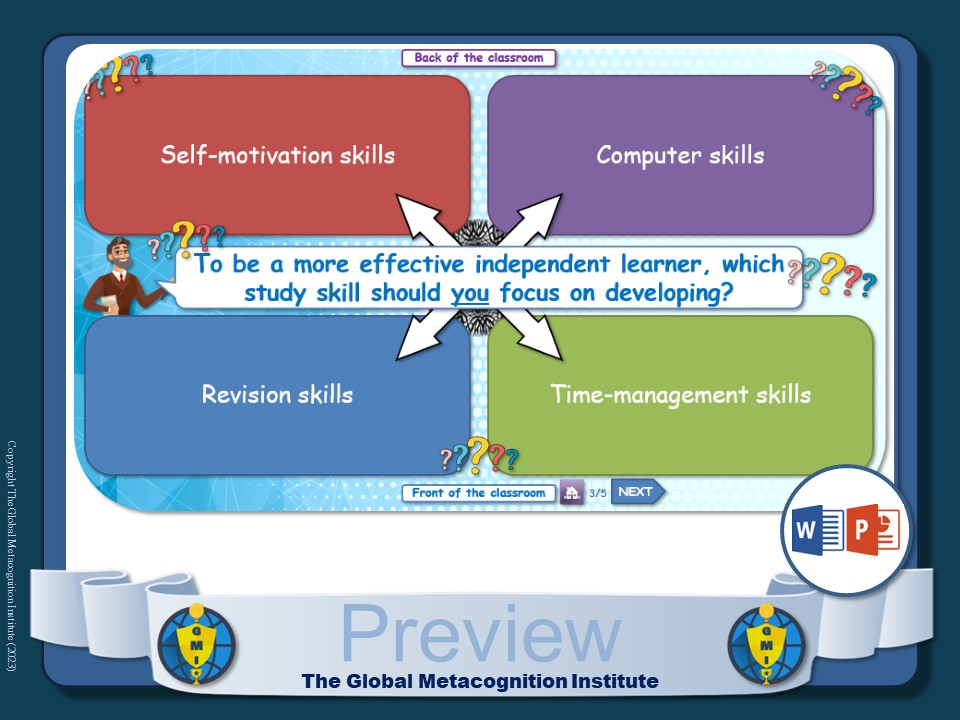
Instructional Materials for Study Skill Development in Schools https://www.globalmetacognition.com/post/instructional-materials-for-study-skill-development-in-schools

What Are Study Skills?

Study skills encompass a range of strategies, techniques, and approaches that students employ to enhance their learning and academic performance. However, the understanding of study skills may vary among individuals and educational contexts. Some view study skills as specific techniques or methods aimed at improving efficiency in studying, such as note-taking, time management, and memorization techniques. For them, study skills are practical tools that help students optimize their learning processes.


Others perceive study skills more broadly, encompassing not only academic skills but also metacognitive abilities, critical thinking, and self-regulation. This perspective emphasizes the development of learners who can reflect on their own learning, set goals, monitor their progress, and adjust their strategies accordingly. In this broader sense, study skills involve not only specific techniques but also the cultivation of a growth mindset, effective problem-solving, information evaluation, and collaboration.


Regardless of the interpretation, the importance of study skills cannot be overstated, as they provide students with the tools and mindset needed to succeed in their educational journey and beyond.


How Can a Focus on Study Skills Benefit Learners?

When teachers focus on developing students' study skills, it brings a multitude of benefits to the learners. Firstly, students gain a set of practical tools and techniques that improve their academic performance. With well-developed study skills, students can effectively manage their time, organize their materials, and employ effective study strategies, resulting in more efficient and productive learning.


Additionally, focusing on study skills helps students develop essential transferable skills such as critical thinking, problem-solving, and self-regulation. These skills go beyond the classroom and are valuable for success in future academic pursuits and professional endeavors. Moreover, as students become more proficient in study skills, they experience increased confidence in their abilities, leading to higher levels of motivation and engagement. Students also develop a sense of ownership and responsibility for their own learning, as they gain the tools to set goals, track progress, and make necessary adjustments.


Ultimately, by focusing on developing students' study skills, teachers empower them to become independent, lifelong learners who are better equipped to succeed academically and beyond.


Tips & Tricks for Study Skill Development

Here are ten effective tips and tricks to help you develop the study skills of your students:

  1. Break It Down: Take study skills step by step, breaking tasks into bite-sized pieces. It's like turning a big sandwich into delicious bite-sized snacks!

  2. Show and Tell: Be the study skills superhero! Show students how you tackle tasks, take notes, and study. Share your tips and tricks like a secret agent sharing classified information.

  3. Mix It Up: Shake things up by offering a variety of study techniques. It's like having a buffet of study strategies - students can pick what works best for them.

  4. Reflect and Grow: Help students reflect on their learning journey. Encourage them to think about what's working and what they can improve. It's like planting seeds of growth!

  5. Team Up: Let the power of teamwork shine! Encourage students to form study groups or find study buddies. Together, they can conquer any challenge that comes their way.

  6. Feedback is Fabulous: Give high-fives with feedback! Offer positive and constructive feedback on students' study skills. It's like sprinkling confetti on their progress.

  7. Tech Time: Embrace the digital era! Explore educational apps and online tools that make studying fun and interactive. It's like bringing a party to their screens!

  8. Real-Life Connections: Help students see the bigger picture. Connect study skills to real-life situations, like solving puzzles or becoming a detective of knowledge.

  9. Resource Adventure: Be their study skills guide! Offer resources like books, websites, or videos that provide extra tips and tricks. It's like going on a treasure hunt for knowledge!

  10. Celebrate Effort: Acknowledge their hard work and effort. Celebrate small wins along the way, like study skill superheroes earning their capes!

Remember, you're their study skills guide, leading the way to success. With these tips and tricks, you'll create a positive and engaging environment that sets your students up for study skill stardom.


Download Our Study Skills Development Toolkit

We've created a toolkit that will help students to develop their study skills. It uses a self-regulated learning approach that encourages students to plan, monitor, evaluate and regulate their approach to study-skills development. Click here to download!

The Study Skills Development Toolkit is a comprehensive and professional resource designed to unlock the full potential of your students' study skills. This toolkit employs a research-backed self-regulated learning approach, enabling students to effectively plan, monitor, evaluate, and regulate their study skill development. It includes a meticulously crafted study-skills reflection workbook, a knowledge-hunt lesson that delves into the intricacies of study skills, and an interactive multi-use lesson for versatile classroom implementation.


Grounded in pedagogical approaches such as reflective learning, independent learning, metacognition, and self-regulated learning, this toolkit equips educators with practical tools to guide students towards study skills mastery. Empower your students, foster academic excellence, and embark on a transformative educational journey with "The Study Skills Development Toolkit." Download now and unlock the door to enhanced study skills and student success.


A Self-Regulated Learning Approach to Study Skills Development

When it comes to study skill development, it is crucial to cultivate independence, autonomy, and a sense of responsibility in students. By encouraging them to take the reins of their study skill development, we equip them with the essential tools to become self-directed learners.


Within this framework, the self-regulation cycle plays a pivotal role. It begins with planning, where students create strategic frameworks to develop their study skills over time. Setting specific and achievable goals allows students to establish a solid foundation for growth.


As students progress, monitoring their study skill development becomes imperative. Regularly assessing their progress enables students to identify areas that require improvement and make informed adjustments to their strategies. Through consistent reflection and self-assessment, students gain a deeper understanding of their strengths and weaknesses in relation to study skills.


Evaluation is the next crucial step in the process. Students need to objectively evaluate their study skills, recognizing both their accomplishments and areas in need of enhancement. This self-reflection fosters self-awareness and helps students identify where their focus should lie when it comes to study skill development. By recognizing their strengths and acknowledging areas for improvement, students can create targeted plans that align with their unique needs.


Regulating the development of study skills involves setting clear targets and goals. By setting specific and measurable objectives, students create a roadmap for their journey of growth. Setting targets provides a sense of direction and focus, guiding students towards their desired outcomes.


To effectively develop study skills, students must be open to change and willing to adapt their approach. By recognizing the need for improvement and making necessary adjustments, students can refine their strategies and practice new techniques. Encouraging students to make deliberate changes to their study habits, organization methods, time management, and note-taking techniques fosters flexibility and resilience in their learning approach.


Promoting independence, autonomy, and responsibility in students is crucial for their study skill development. By embracing the self-regulation cycle, students learn to plan strategically, monitor their progress, evaluate their study skills, and regulate their development. Encouraging students to set clear targets, adapt their strategies, and embrace change empowers them to become active participants in their own learning journey. As educators, let us nurture independence and autonomy in our students, guiding them towards study skill mastery and lifelong success.


from The Global Metacognition Institute https://www.globalmetacognition.com/post/instructional-materials-for-study-skill-development-in-schools
via https://www.globalmetacognition.com/

Monday, 6 May 2024

Metacognitive Strategies: Free Downloads for Teachers & Schools https://www.globalmetacognition.com/post/metacognitive-strategies-free-downloads-for-teachers-schools

At the forefront of educational innovation, The Global Metacognition Institute pioneers a diverse range of teaching resources, meticulously crafted to amplify the impact of reflective learning, self-regulated learning, and metacognition within school environments. Embark on a journey of pedagogical excellence with the unique tools and insights offered on our platform...

Click on the picture to explore our range of free metacognition teaching resource downloads!


What is Metacognition?


Metacognition, often referred to as "thinking about thinking," is a crucial cognitive skill. It involves understanding how we learn, the strategies we use to learn, and our awareness of our own learning processes. In essence, metacognition encourages students to become mindful of their learning journey. By fostering metacognitive skills, educators empower students to monitor their progress, set goals, and adapt their learning strategies accordingly.


What is Self-Regulated Learning?


Self-regulated learning (SRL) is the ability to take control of one's learning process. It encompasses setting goals, planning, monitoring progress, and adjusting strategies as needed. SRL encourages students to become active participants in their education, making decisions about what and how they learn. By developing self-regulated learning skills, students become more independent and efficient learners, ultimately leading to better academic outcomes.


What is Reflective Learning?


Reflective learning involves the practice of looking back on one's learning experiences and extracting valuable insights. It encourages students to think deeply about what they have learned, how they learned it, and how they can apply this knowledge in different contexts. Reflection fosters critical thinking, self-awareness, and a deeper understanding of the subject matter. It also encourages students to connect their learning to real-life situations.


Transforming Education, One Resource at a Time!

Welcome to The Global Metacognition Institute, your gateway to a brighter, more effective classroom experience. We are your premier source for cutting-edge educational resources, meticulously designed to elevate your teaching and empower your students in five transformative ways.


Boost Metacognition: Unleash Cognitive Excellence!

Unlock the true potential of your students' minds with resources that nurture metacognition—the ability to think about thinking. Elevate their learning experience by helping them understand their own thought processes, set meaningful goals, and take charge of their educational journey. When students become aware of how they learn, academic success becomes a natural outcome.

Create Independent Learners: Fuel Self-Driven Success!

Say goodbye to passive learning! Our resources empower you to cultivate independent learners who take initiative and responsibility for their education. Watch as your students set and achieve goals, plan their learning paths, and become self-reliant, motivated scholars, ready to thrive both in and beyond the classroom.


Boost Reflective Learning: Cultivate Wisdom and Insight!

Prepare your students for a world of limitless possibilities with our reflective learning resources. Encourage them to delve deep into their experiences, connect the dots between theory and practice, and apply newfound wisdom to real-life situations. Reflective learners are critical thinkers poised for success in the ever-changing landscape of the future.


Enhance Dedicated Improvement & Reflection Time (DIRT)

Our resources are designed to elevate Dedicated Improvement & Reflection Time (DIRT) into a catalyst for growth. Transform your classroom into a hub of continuous improvement as students review their work, receive valuable feedback, and set ambitious goals. Watch as they become more engaged, proactive, and invested in their own learning journeys.


Promote Self-Regulated Learning: Prepare for Lifelong Success!

Empower your students with the invaluable skill of self-regulated learning (SRL). By taking control of their learning processes, setting goals, planning, monitoring progress, and adjusting strategies, they become independent, adaptable, and resilient learners. Equip them with the tools they need for lifelong success in today's dynamic world.


Join the ranks of educators worldwide who have embraced The Global Metacognition Institute's resources to revolutionize their classrooms. Transform the way you teach, and witness your students flourish like never before.


from The Global Metacognition Institute https://www.globalmetacognition.com/post/metacognitive-strategies-free-downloads-for-teachers-schools
via https://www.globalmetacognition.com/

Generation Z in the Classroom: Teaching Strategies, Metacognition and AI https://www.globalmetacognition.com/post/generation-z-in-the-classroom-teaching-strategies-metacognition-and-ai

A major review by Sarah Chardonnens (2025) examines what research tells us about educating this generation, with a particular focus on activ...